
Why Alcaraz Underutilizes The Backhand Slice
How The Spaniard Is Still Number One Without It
2/18/20264 min read
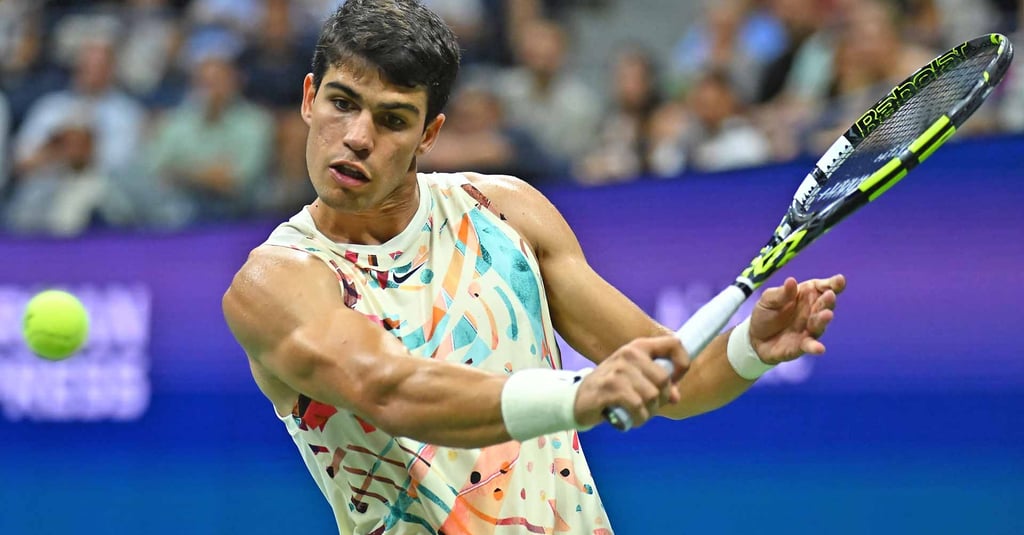
One of the main reasons Carlos Alcaraz can beat his main rival, Jannik Sinner, is that he is one of the most versatile players in tennis history. But one interesting thing about Carlos’s versatility is that it doesn’t include the backhand slice. Don’t get me wrong, Carlos does slice, more specifically when he’s in defensive situations, but even there, he has one of the strongest defensive two-handed backhands of all time. And he will occasionally use the backhand slice as an approach shot, but compared to his two-handed backhand, he doesn’t utilize the slice that much.
Extra Aggression
So how does that fit within his versatility as a player? Because ultimately, the one-handed slice backhand is the ultimate versatility shot. But one thing that separates Carlos Alcaraz from other versatile players is that his versatility is always accompanied by aggression. And a backhand slice is certainly a great tactic to utilize, but it’s seldom going to be a shot that you hit a winner with. It is the slowest groundstroke right behind the drop shot.
But how does a drop shot compare to a slice backhand? It happens to be slower than a slice. Well, that particular shot, especially when it’s hit by Carlos Alcaraz, is a far more aggressive shot compared to the slice backhand. Carlos Alcaraz will hit winners with his drop shots, but he will not hit winners and not put his opponents under that much pressure with a backhand slice.
Certain Situations
Now, when we talk about power, this, of course, doesn’t include the drop shot or when Carlos comes to the net, but that certainly is a very aggressive play style. So, back to the slice: Carlos does utilize it here and there. He does more so on grass. There was a very interesting rally with Lehecka at Queen’s.
In the Wimbledon final against Sinner, he also utilized some slices. He does it occasionally on clay, but as I said, the reason why Jannik Sinner and Alcaraz don’t hit that many slices is that even when they get a low ball, they’re so athletic. They can get down to the low ball and execute aggressive topspin two-handed backhands. They don’t rely so much on the defensive slice.
And even as an approach shot, they can manipulate the two-handed backhand so well that it’s almost a waste to hit a slice when you can hit a very aggressive shot. So it comes down to Alcaraz changing up the pace and the height of the ball, and occasionally, on grass, he will utilize slices to keep the ball low.
Technique
Now here’s the interesting thing: Alcaraz does have a very clean slice technique, but sometimes there are some unorthodox elements on his one-handed backhand slice. So let’s take a look at the clean slice backhand of Carlos Alcaraz, which happens to be a U-shaped slice backhand.
So in any case, Alcaraz starts high with his racket, and he has a circular swing path like any other slice backhand at the high level. Now he will make contact around the tip of his front foot, and he will go across the body. This is a fundamental element of the slice backhand.
Different Finishes
Now, when it comes to the finish on the slice backhand, this is where we’re going to see some stylistic differences. So when Carlos Alcaraz hits his slice backhand very clean, he will start high, hit across the body, and stop somewhere with the tip of the racket pointing straight forward and the strings parallel to the ground. This is the cleanest way to finish on the slice backhand.
However, sometimes, especially in that match against Lehecka at Queen’s, Alcaraz displayed some unorthodox elements on his one-handed backhand slice finish. So it would go across like on all his other slices, and the racket would go out as if he’s hitting a one-handed backhand. So the finish was very awkward.
Contact
Now Carlos Alcaraz is an absolute genius when it comes to the feel around the ball. However, at the recreational level, the finish is important. And what I find with a lot is that if they’re wild on the finish, if the racket is flailing, the wrist starts getting activated, and the racket is going all over the place, which can actually affect the contact itself. And if the contact is too sloppy, too unstable, a good way to fix it is to control your finish.
Because you’re not going to be able to influence the contact that much, the contact on the slice, just like any other shot in tennis that’s hit with good acceleration, is over in a millisecond. So by intending to finish a certain way, you can influence the contact. And by intending to have the tip of the racket pointing forward and the strings parallel to the ground, you’re going to have a better chance to hit the ball cleanly right at the moment of contact.
Modernized Game
But modern tennis is all about topspin, powerful groundstrokes, and athleticism. So as tennis evolves, we’re going to see far less one-handed slice backhands. Now, we’re not necessarily going to see fewer drop shots and less versatility because those are aggressive shots. But when it comes to shots that are purely designed to change the tempo of a match and draw errors from the opponent, we’re going to see less and less of that because players generally are better at handling slices.
And when we’re talking about the number one and two players on the ATP rankings, those guys are so exceptional at handling low balls. So it’s for that reason that both Jannik Sinner and Alcaraz hit relatively few one-handed backhand slices.
Final Thoughts
What does this mean for you at the recreational level? Well, it means that you shouldn’t listen to what I just said, and you should practice your one-handed backhand slice because there is a family of shots in the game of tennis. And these shots include the one-handed slice backhand, the one-handed backhand drop shot, and the one-handed backhand volley. All these shots are similar in that they share the same continental grip, a very similar high-to-low swing path, and an overall feel that is very similar.
Of course, there are important differences as well, and you have to practice these three shots individually. But one thing is true: if you get good at the one-handed backhand slice, your development of the one-handed backhand volley and the one-handed backhand drop shot might improve with improvements in your one-handed backhand slice. I highly encourage you to practice your one-handed backhand slice, as it can improve your overall game and make you a more versatile player.